
Timeline
7 weeks (2021)
Project Overview
Every year, around 5 billion coffee cups are consumed ‘to go’ in Canada alone. The vast majority of those cups are single-use, ending up in landfills or incinerators. It’s a problem that feels small in the hand but scales into a massive environmental burden.
As part of a 7-week co-design project with Zero Waste Canada (ZWC), our team of three was tasked with exploring how to reduce single-use waste in Canadian communities. We chose to focus specifically on single-use coffee cups on post-secondary campuses; a space where coffee consumption is rising, habits are forming, and students have both the influence and the motivation to lead change.
Through secondary research, systems analysis, and close collaboration with ZWC’s team and subject-matter experts, we designed Round Table: a student-led club that partners with campus cafes to replace disposable cups with a shared system of beautifully designed, reusable ones.
The idea wasn’t just to give students a reusable cup. It was to redesign the system around them so that the sustainable choice became the easy choice.
Understanding the System
Rather than jumping to solutions, we spent the first two weeks immersed in secondary research on waste in Canada, specifically around single-use disposable cups. This was a co-design process. We met regularly with Zero Waste Canada’s team and their subject-matter experts throughout the 7-week project.
The research led us to a critical insight: the coffee cup problem isn’t really about cups. It’s about the system that produces, distributes, and disposes of them. To understand that system, we built two key tools.
System Map
We mapped the full system of students buying coffee on Canadian campuses, tracing the factors that determine whether a student receives coffee in a reusable cup or a single-use one. The map revealed that the outcome depends on a web of interconnected factors: whether there’s a surcharge on disposable cups, whether there are campus sustainability policies in place, whether social media is influencing behaviour, whether reusable cup services exist nearby, and whether there’s a discount for bringing your own cup.
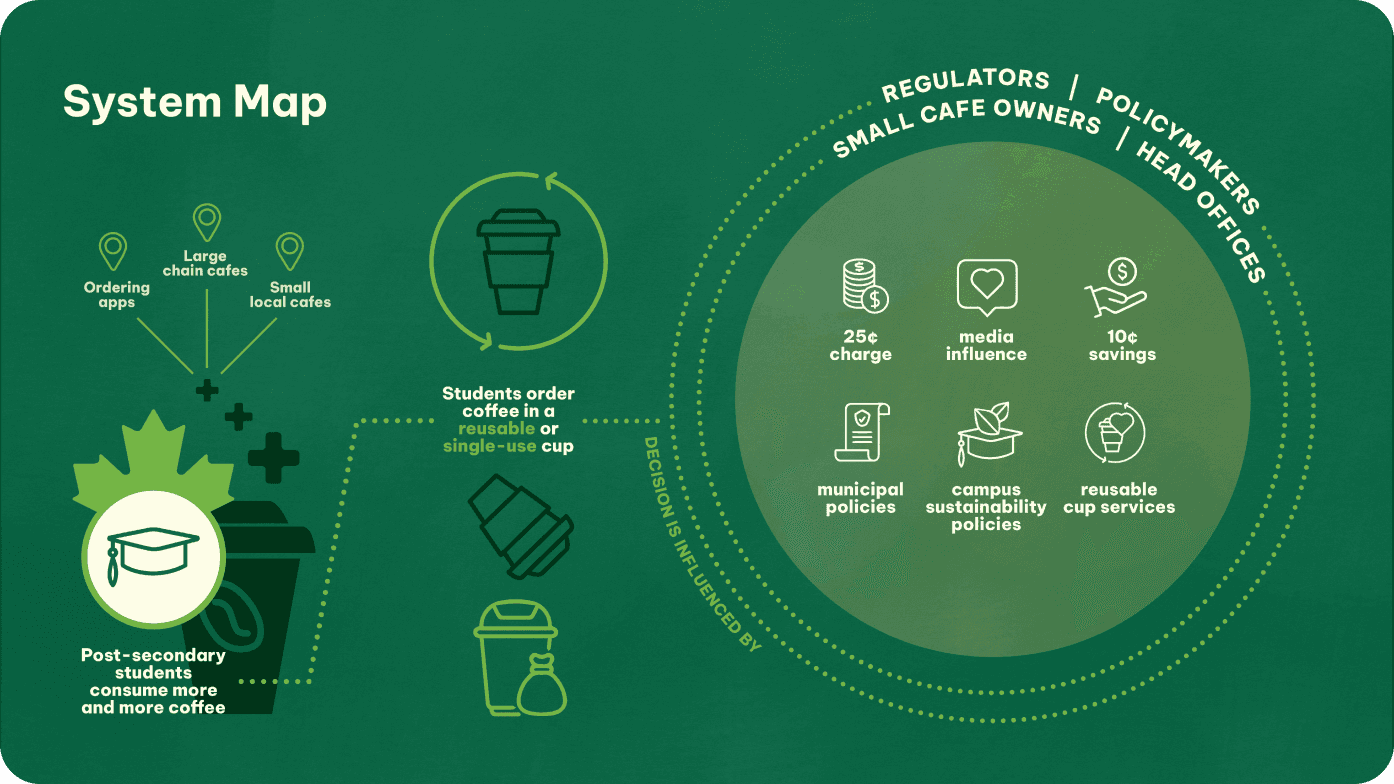
The map made something clear: to make the greatest impact, we needed to focus not just on individual students, but on the people with the most control in the system:
policymakers
regulators
cafe owners
decision-makers at large coffee chains
Personas
We developed two personas to represent the key stakeholders in this system. Ashley, a 25-year-old Public Relations student, captures the student perspective: she needs her daily coffee fix but cares about the environment and wishes it were easier to do both on campus. Aaron, a 35-year-old cafe manager, represents the business side: he doesn’t want to keep ordering disposable cups, but knows that customers will always forget their reusable mugs.

Ashley, 25
Public Relations Student at Algonquin College
“I need my coffee fix everyday but I also care about the environment. I wish it were easy to do both on campus.”
Needs:
Daily dose of caffeine for productivity
Campus sustainability initiatives
Pain Points:
Guilt from single-use products
Mental stress due to assignments

Aaron, 35
Cafe Manager at Algonquin College
“I don’t want to order so many single-use cups, but the reality is people will always forget to bring their reusable mugs.”
Needs:
Effective budgeting of supplies
Helping hand to work without too much stress
Pain Points:
Lack of labour for sustaining initiatives
Low take-up of initiatives by customers
Both personas pointed to the same gap: the system asked individuals to solve a structural problem. Ashley felt guilty when she forgot her mug. Aaron lacked the labour and infrastructure to sustain green initiatives on his own. Neither of them could fix the system alone.
The Problem Statement
How might student-led initiatives pressure retailers to shift away from single-use cups?
This framing was deliberate. It placed the agency with students; the demographic with the most to gain from building sustainable habits while directing the pressure toward the retailers and systems that control what kind of cup a customer receives. The goal wasn’t just awareness; it was structural change.
The Solution: Round Table
Round Table is a student-led club that partners with cafes and restaurants across campuses to serve coffee in well-designed, reusable cups. By promoting shared ownership of cups within the campus community and ensuring coffee cups never reach a landfill or incinerator, Round Table helps campuses move towards a zero-waste system.
Design Principles
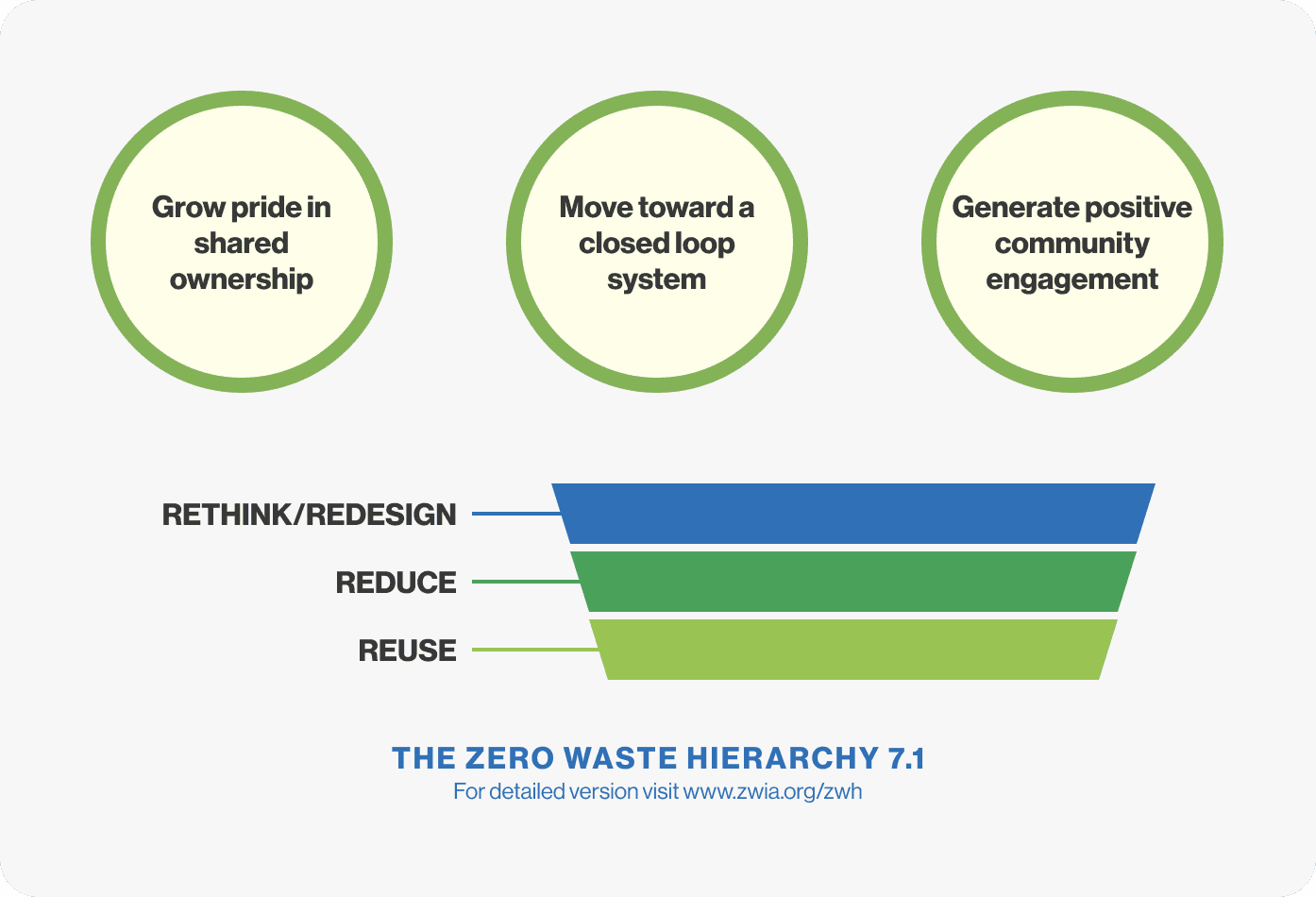
Every design decision followed principles that mapped directly to the top of the Zero Waste Hierarchy, as defined by the Zero Waste International Alliance. The hierarchy prioritizes, in order:
rethinking and redesigning the system
reducing potential waste
promoting reuse
Round Table’s design sits at this intersection. It doesn’t just offer a reusable cup, it rethinks who owns the cup and how the system circulates it.
How It Works
The system is designed to be as frictionless as possible, removing the burden of remembering a personal mug and replacing it with a shared infrastructure:
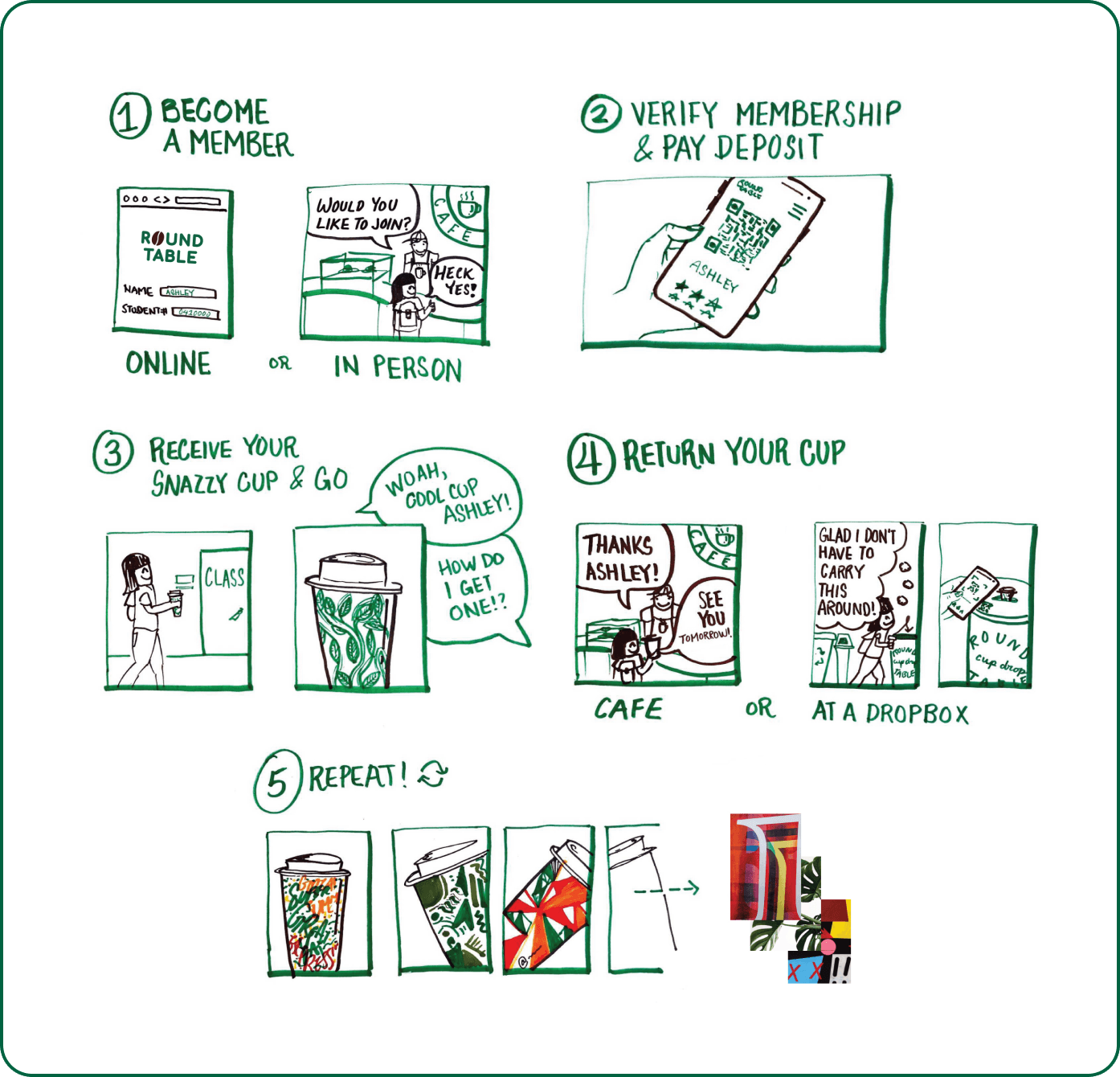
First, a student becomes a member of Round Table, either through an online form or in person at a participating cafe. As a member, the student can walk into any campus cafe, verify their membership through the club’s app, and pay a small deposit for a reusable cup. The cups themselves are beautifully designed by students from Algonquin College’s School of Media and Design, making them something people actually want to carry around campus.
After class, the student returns their cup either to a barista or to a secure drop box on campus, scanning a code to verify the return. The deposit is refunded. Club members collect the cups from drop boxes, scan them for tracking, and send them to industrial dishwashers on-site for thorough cleaning. Then the cups go back into circulation.
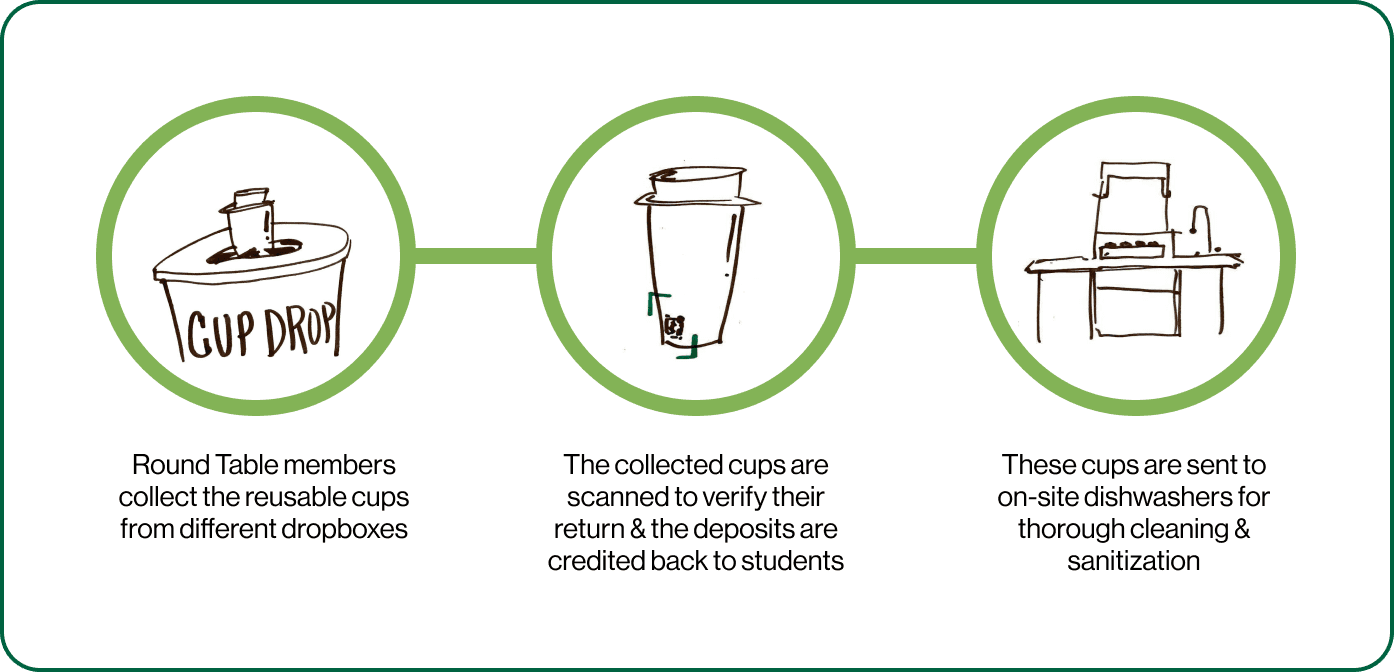
The result is a closed loop: cups move from cafe to student to drop box to dishwasher and back again.
No cup reaches a landfill.
No student has to remember a mug.
Making It Work
A reusable cup system only works if the ecosystem around it is strong. Round Table was designed with three pillars in mind, the same three pillars identified by Zero Waste Canada as essential for zero-waste initiatives:
Community, Business, and Government.
Partnerships
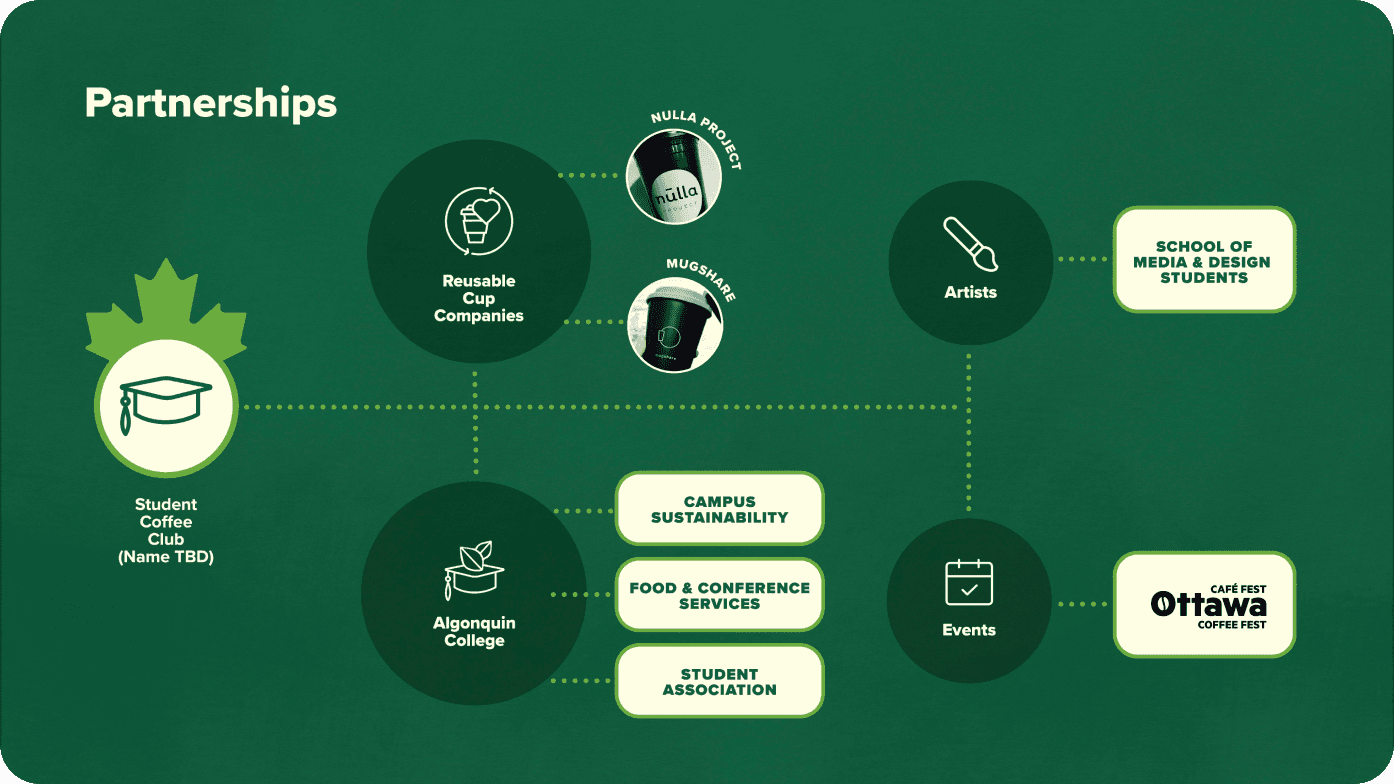
Round Table’s success depends on partnerships at multiple levels. For cups, the plan is to partner with existing deposit-based reusable cup services in Canada; companies like Mugshare or The Nulla Project that provide cups made of fully recyclable plastics, moving toward a closed-loop material system. For design, students from Algonquin’s School of Media and Design would create the artwork using environmentally conscious inks and printing processes.
At the institutional level, Round Table would work with Campus Sustainability, Food and Conference Services, and the Student Association at Algonquin College to make the service available across all campus cafes and restaurants. This aligns with the college’s own strategic plan, which commits to expanding sustainable business practices. And for community engagement, Round Table could partner with events like Ottawa Coffee Fest to expand the celebration of coffee culture to include reusable cups at the centre.
Student Engagement
Students aren’t just users of Round Table. They’re active participants in running it. Club members manage cup collection, educate peers, and maintain the drop-box infrastructure. This model of shared responsibility means the initiative isn’t dependent on institutional staff; it’s sustained by the community it serves.
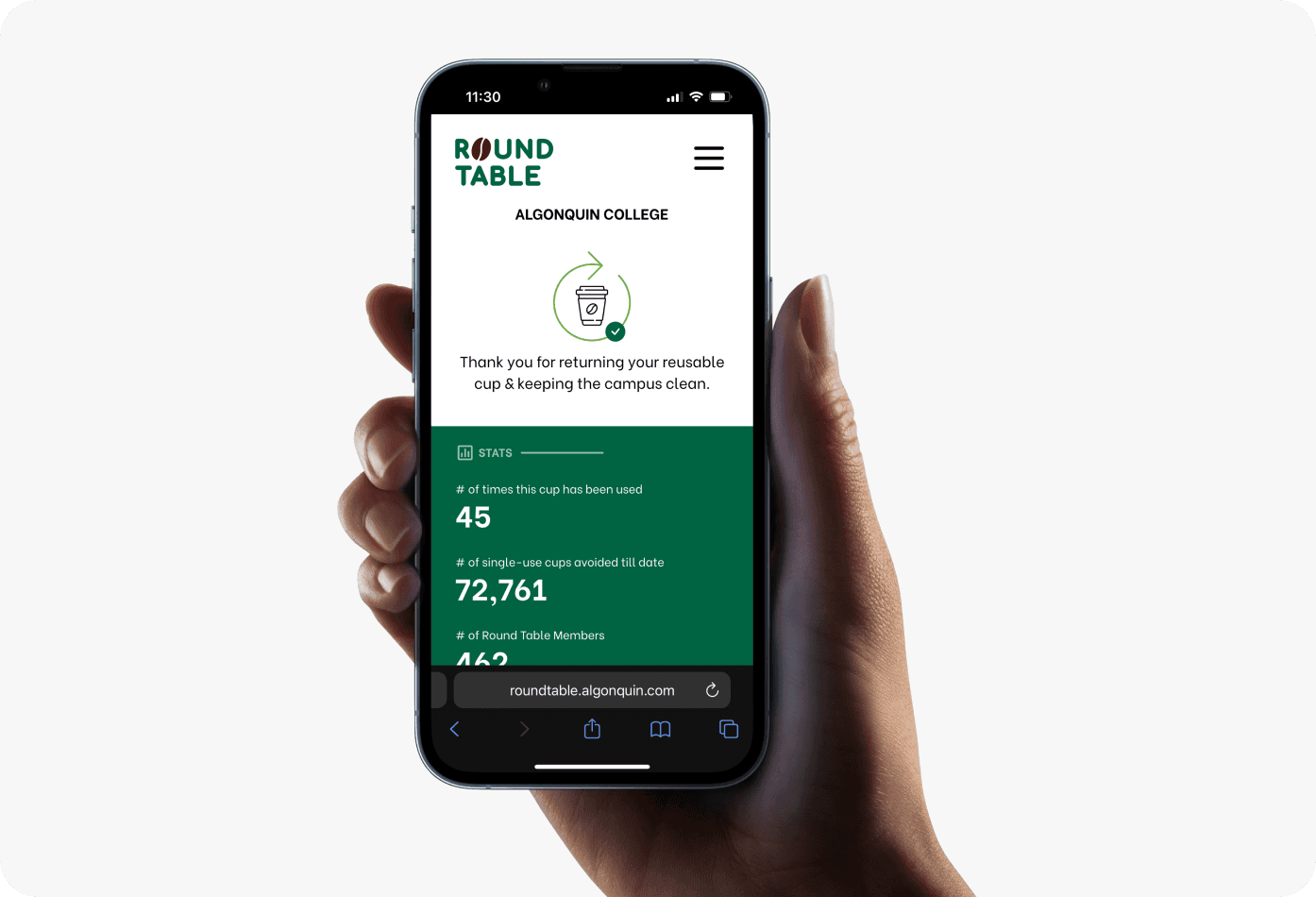
To drive engagement, we designed an incentive system tied to the QR code students scan when returning cups. Members can track the number of times their cups have been reused, and after every 10th return, they earn a free coffee. The convenience of campus-wide drop boxes, combined with tangible rewards, is designed to make participation feel easy and worthwhile.
Policy Considerations
Round Table was designed to work within existing policy frameworks while also pushing them forward. The team worked with the understanding that Algonquin’s Food and Conference Services had paused incentive programs for customer-brought reusable cups during COVID-19, but expected to resume them. The University of Ottawa had already turned to reusable takeout containers from OZZI during the pandemic, demonstrating that institutional appetite for these solutions existed.
By establishing a working model on one campus, Round Table could serve as proof of concept for broader policy changes demonstrating to administrators, municipalities, and eventually federal regulators that deposit-based reusable cup systems are viable at scale.
Scalability and Next Steps
Round Table was designed to work within existing policy frameworks while also pushing them forward. The team worked with the understanding that Algonquin’s Food and Conference Services had paused incentive programs for customer-brought reusable cups during COVID-19, but expected to resume them. The University of Ottawa had already turned to reusable takeout containers from OZZI during the pandemic, demonstrating that institutional appetite for these solutions existed.
By establishing a working model on one campus, Round Table could serve as proof of concept for broader policy changes — demonstrating to administrators, municipalities, and eventually federal regulators that deposit-based reusable cup systems are viable at scale.
Measuring Success
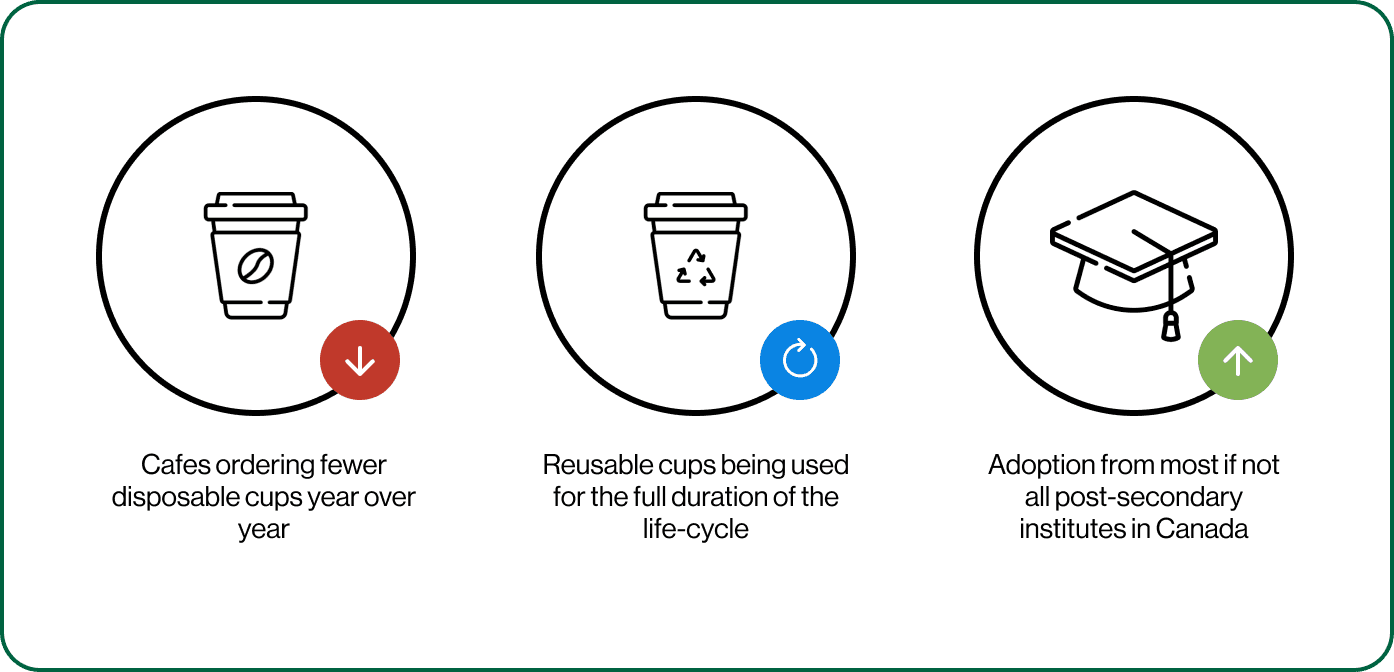
We defined three core metrics to track whether Round Table is achieving its goals. First, cafes ordering fewer disposable cups year over year, a direct measure of whether the system is displacing single-use spin-offs. Second, reusable cups being used for the full duration of their life cycle, tracked through the QR code system, with a target of at least 90% life-cycle utilization. And third, adoption from other post-secondary institutions, measuring whether the model is replicable beyond its pilot campus.
Potential Challenges
We identified two primary risks through our validation with Zero Waste Canada. The first is students not returning their cups. The mitigation is twofold: regular reminders through the app, and the deposit model itself. Students have a financial incentive to return. As we noted in our proposal, if students can return a library book, we can encourage them to do the same with a cup they’ve paid a deposit for.
The second challenge is the management and maintenance of drop boxes across campus. Round Table addresses this through its club structure: members are not passive consumers of the solution but active leaders who maintain the infrastructure and educate their peers. The responsibility is distributed, not centralized.
Reflections
Round Table emerged from a systems thinking approach. Rather than designing a product and hoping people would adopt it, we mapped the system first, identified who held the most leverage, and then designed an intervention that applied pressure at the right points. The result isn’t a cup. It’s a system that makes reuse the default.
The 7-week co-design process with Zero Waste Canada was central to this. Their three pillars; Community, Business, and Government gave us a framework for thinking beyond the individual user and designing for the ecosystem. By working with their subject-matter experts throughout, we ensured the solution wasn’t just technically sound but aligned with the principles of zero-waste advocacy.
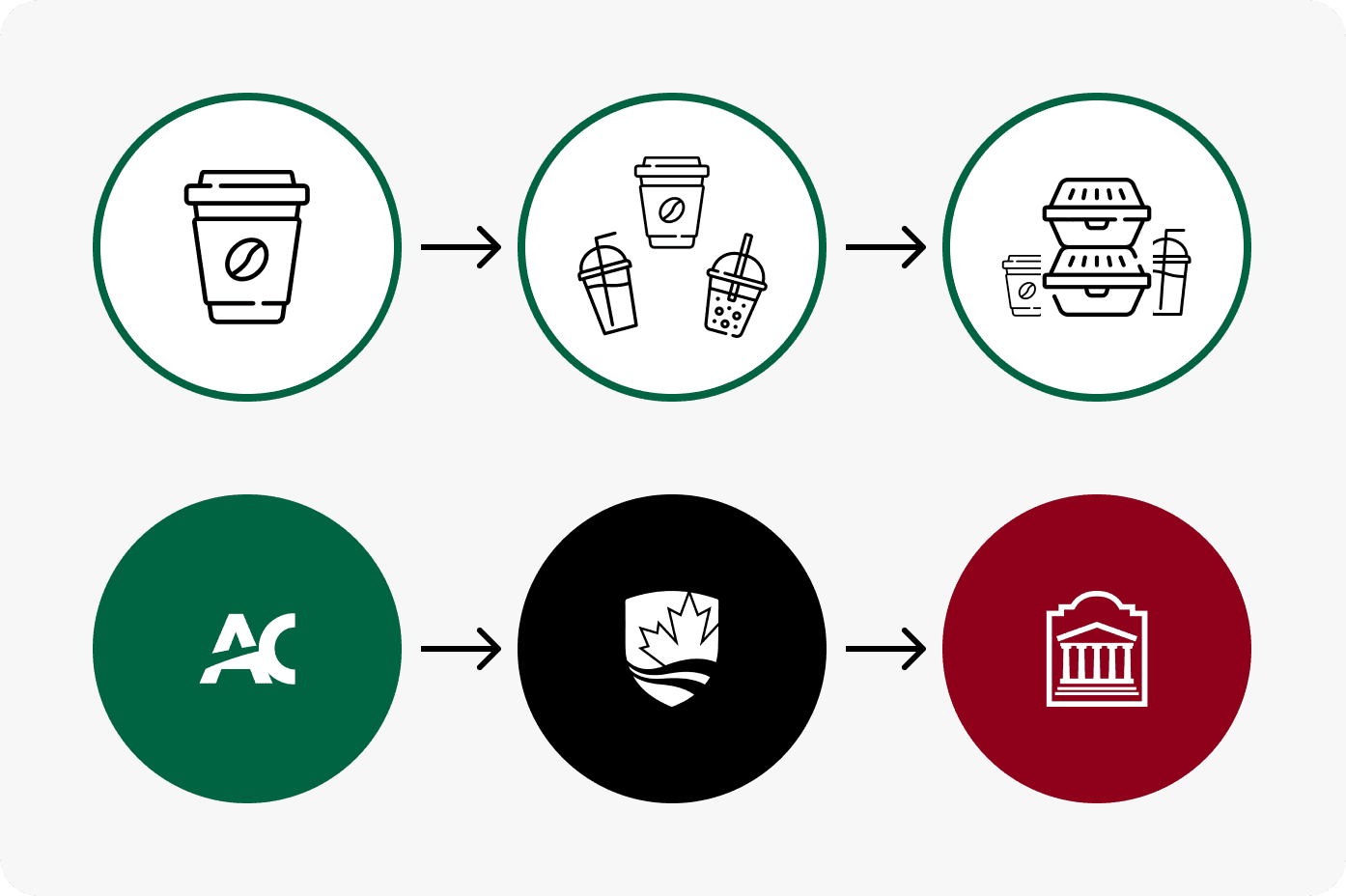
What excites us most about Round Table is its transferability. The model isn’t specific to coffee, or to Algonquin College, or even to campuses. It’s a template for how student-led initiatives can create shared infrastructure that makes sustainable choices effortless. If the pilot succeeds, it becomes a proof of concept that can be adapted, replicated, and scaled. One campus, one cup, one system at a time.
Because the best way to reduce waste isn’t to ask people to change their habits. It’s to change the system so the habit doesn’t matter.